An image showing a bug of some kind sat sitting on a handrail observing a railway line somewhere near Tilehurst station.
As a proud owner of an English Language O’level from back in the day, I thought I would spend a little time re-learning how to write betterer & a bit more descriptive like. Following a bit of online research on the subject of travel writing I decided to invest in a real book titled ‘The Travel Writers Way’ by Jonathan Lorie (as opposed to an unreal one that is viewed on a tablet thing). Full of brilliant hints & tips, I am now in the process of re-reading the text with a view to undertaking some of the assignments within. In order to keep you abreast with my developments, I thought I would share with you a few paragraphs of my progress from the second assignment.
Assignment 2: Take your notebook for a walk & try & capture the character of the whole area.
Here goes….
Although I had many years ago cycled around the Arc du Triomphe in the rush hour, nothing could prepare me for stepping out on to the zebra crossing on the Oxford Road at the base of Norcot Hill. As vehicles screeched to a halt in clouds of bluey-white smoke, I proffered an obligatory thumbs-up gesture to earnestly thank the drivers for not actually killing me & was rewarded adequately by a single-digit reply from a scruffy looking geezer in a white van. Sweeping around a righthand bend onto Cow Lane, my senses were suddenly struck with the scent from a mobile gourmet food establishment whereby a large, red-faced rotund gentleman dressed in workman’s clothes, was tucking into something large, greasy & enveloped in a white napkin. He gave me an upward nod & I returned the gesture whilst momentarily considering where the nearest functional defibrillator was. Finding my route somewhat blocked with a line of parked cars, I edged past managing to shower said cars with thousands of dead pine needles from the bushes to their side. Passing under an arched, brick tunnel that allowed vehicular access beneath Brunel’s Great Western railway line & towards the River Thames, I spotted a cheeky & somewhat, anatomically accurate fertility symbol, artistically drawn on a Network rail sign.
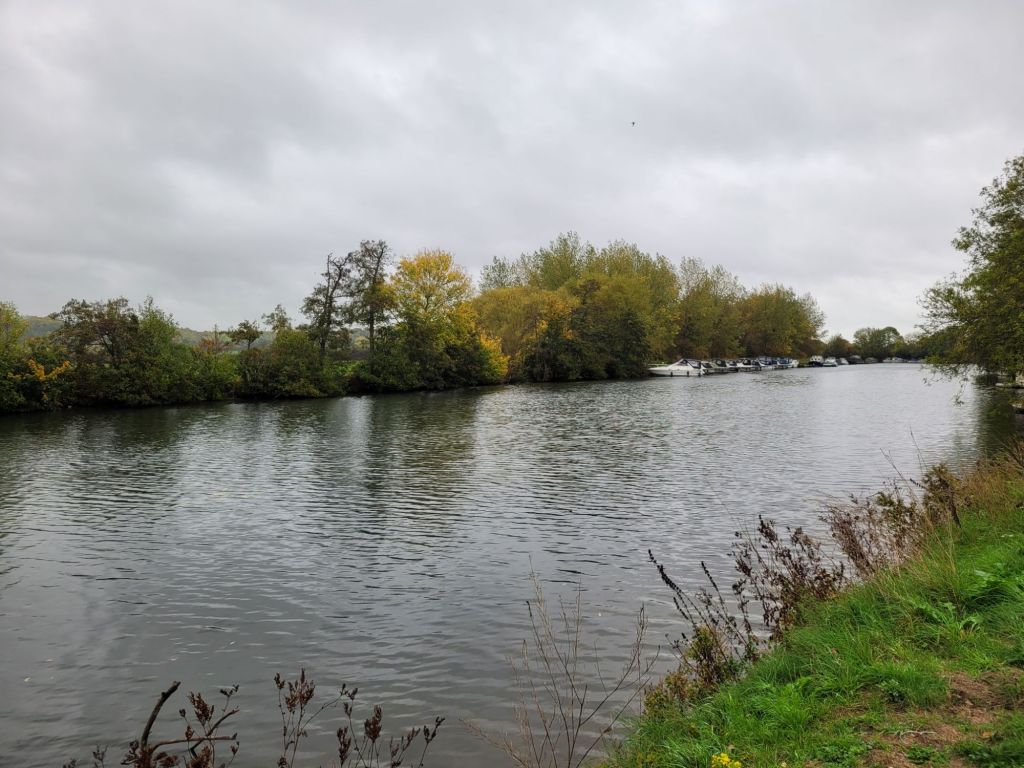
Bearing left at the marina, I started walking alongside the river itself with the damp, semi-impacted gravel crunching beneath my brand-new, blue with luminous orange soled Skechers trainers costing £105. Tunnelling my route, the trees & bushes were all in a different stage of autumnal shedding with some leaves yellow, some brown & some still a vibrant, healthy green. Bunches of bright crimson berries hung pendulous from the thin, spikey branches of the hawthorn, possibly blackthorn, a stark contrast to the damp drabness around. Pausing momentarily to attend to the intricacies of micturition in a secluded bush, I gazed out over the millpond like river while a fancy white motorboat chugged downstream before me, the wake slapping the banks below my feet. With my free hand I waved, but alas I fear they didn’t see me. A sudden wail of a siren in the distance broke the serenity & I carried on in an upstream direction progressing alongside a curved, graffiti-stained, dark-brick retaining wall structure with huge, towering galvanised steel gantries perched above. Craning my neck momentarily to look up, a green, high-speed train whooshed by at an alarming rate, which happened to scare the f**king bejeezus out of me. This was replaced just a minute later by the throaty womp, womp, womp of a more sedate, scarlet-coloured Deutsche Bahn goods loco, hauling wagons of pink containers. Further along the path, the bushes now gave way to mature horse chestnut trees which at this stage of autumn were now completely bare, their once green leaves now lying dead in piles on the ground. I stood in silence as a few of their comrades floated downstream like er, corpses, er, floating downstream. The seeds of the tree, once cherished by schoolboys, now littered the ground although amongst them I spied an imposter in the shape of a small, freshly deposited dog log. Chiding the carelessness of the owner under my breath I flicked it with a stick into the river. Rounding a shallow bend, I caught a feint whiff of woodsmoke that soon became combined with the not so feint whiff of cannabis, which was being emitted from somewhere within a rather run-down narrowboat. A blue, weathered tarpaulin slung haphazardly over the middle roof section, indicating that time had not been kind to this vessel. Someway beyond at the edge of the bank I spied a gruff-looking fellow with sunken red eyes sat in a collapsible picnic chair, his hand welded onto a can on Polish lager. Venturing past & to his rear I bade him a cheery good morning to which he replied just a single solitary word, “wankers”. I decided it was now time to head on home.
It was a welcome relief to be free from the masses (& Frank Skinner) in the tourist trap of Notting Hill. Turning onto Bayswater Road I briefly surveyed the old Ordnance Survey & decided that I fancied a saunter around the area about St Pauls, that was after I fancied a little teriyaki in a high-street, take-away noodle-bar (not particularly sure if they are all hyphenated, but hey, it’s my blog & as such, can say & do what I like (obviously within reason, as I wouldn’t want to offend anyone (actually, funnily enough, I do seem to offend people quite a lot (Hmmm, must be something to do with my military heritage & being a cantankerous old git)))).
An image showing a rather deserted Notting Hill Gate tube station, with train approaching.
Embarking the Central Line underground train bound for Epping at Notting Hill Gate tube station, over the course of 12 minutes I was rattled, shunted & vibrated under Bond Street, Oxford Circus & Tottenham Court Road, until I arrived thoroughly blended at my next destination, St Pauls. The Cathedral (designed by Sir Christopher Wren & built 1675-1710) itself is one of those places that simply takes my breath away & had I been visiting, I would probably discuss the refinements of it in a little more detail. I wasn’t & so I haven’t. Instead, I wandered around the immaculately kept Paternoster Square & eyed its impressive temporary sculpture of ‘Wild animals on a scooter’ by Gillie & Marc, as well as the more permanent ‘Sheep & shepherd’ by Elizabeth Frink. Tempted as I was to hoof some kids off the scooter so that I could take a brat-free photo for t’gram, I decided against it & surveyed the grand archway that leads back towards St Paul’s, instead. Temple Bar Gate, as I found out (designed again by Sir Christopher Wren & built in 1669-72 by the way)was originally located at the point of demarcation between The Strand & Fleet Street (a ‘bar’ literally being a barrier to block the road & not in this instance, a house of refreshment) & was moved, lock, stock & barrel to Theobald’s House (somewhere in Hertfordshire) in 1880 to become the posh gateway to a wealthy chaps estate. Here it stayed until 2003 when it travelled back (via the Metropolitan Line obviously) to its current location. In light of this I would suggest going down sometime schnell-ish as you never know where it’ll pop-up next.
An image showing Temple Bar Gate with St Paul’s Cathedral behind
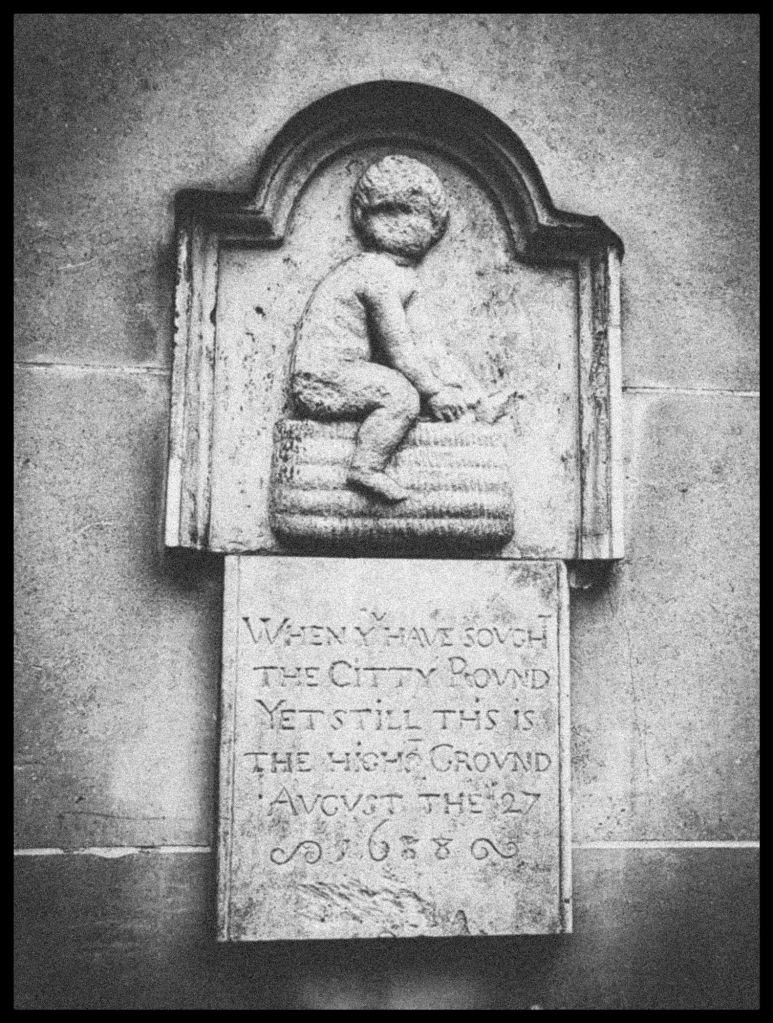
Venturing back across Paternoster Square & onto Paternoster Row, I wandered along Panyer Alley to observe the statue of a baker boy sat atop of a breadbasket. This little chap pays homage to the bakers who’d sell their wares on the streets to avoid paying a tax levied by the king.
An image showing the Baker Boy memorial.
Reaching Newgate Street I banked to the left & moseyed quite amiably to the Viaduct Tavern. Having been led to believe that there were actual cells from the former Newgate Prison located under this very licensed premises, I entered within only to discover that they had a limited supply of ales on tap, having had a pump malfunction. I left at this point & decided to complain to a higher power about this absolute travesty in the Holy Sepulchre Church next door. Once inside my thoughts of refreshment faded into insignificance as it became highly obvious that part of the church formed the Chapel to the Royal Fusiliers, with many of their ‘Regimental Colours’ displayed in the ceiling space above (A ‘Colour’ BTW is a sacred flag which honours the various battles a Regiment has fought in (think Trooping the Colour)). This historic regiment within the British Army was first raised at the Tower of London in 1685 to safeguard the arsenal of weapons & gunpowder contained within. According to the Regimental museum website (www.fusiliermuseumlondon.org/history) a ‘fusil’ refers to a flintlock musket that they were armed with. I must say that it was a rather sobering experience to see the Colours with signs of battle damage hanging above.
An image showing a selection of Regimental colours from the Regiment of Fusiliers, displayed within the church of Holy Sepulchre.
The church itself, & the land all around in fact, had a quite an interesting yet sordid & morbid history to tell. Between the Church of St Sepulchre-without-Newgate (as it was once known) & Newgate Prison (now The Old Bailey directly opposite), was a site of public execution & the tolling of the church bell would inform the locals of an impending dispatching. From 1783 to the time public executions were abolished in 1868, it is believed that 1130 people had felt the hangman’s noose around their neck at that very location. But that is not all, oh no, for located on a pillar inside the church is a little box with a handbell contained within. This is a replica of the bell used to give 12 solemn towles (not towels or even trowels as spell check keeps suggesting I amend it to) to awaken the condemned in their cell at midnight, where upon a verse was recited 3 times:
All you that in the condemned hole do lie, Prepare you, for tomorrow you will die.
Watch all, and pray, the hour is drawing near
That you before the Almighty must appear.
Examine well yourselves, in time repent,
That you may not to eternal flames be sent.
And when St Sepulchre’s Bell in the morning toll,
The Lord above have mercy on your souls.
Half tempted to open the box & give the bell a good clang, I thought better of it & decided to continue my wander. Outside the grounds & avoiding any mobs still loitering in anticipation of an execution, I skirted around the perimeter onto Giltspur Street, where I spied a little building with the words ‘Watch House’ inscribed above the door. This, I learnt, was a precursor to a modern-day Police Station & would of at one time housed security guards who protected the graveyard from ‘London Burkers’, grave robbers modelled in the stylie of Burke & Hare (well-known body snatchers in Scotland), who would dig up fresh corpses & sell them to St Bartholomew’s Hospital directly opposite. How delightful. In a more temporarily cheerful note, to the side of the Watch House door was a bust of Charles Lamb, the English essayist, poet & antiquarian. (I could, if I could be bothered, also mention about the Peasants Revolt that occurred in Giltspur Street in 1381, but I won’t).
Feeling now in need of something a tad less depressing & a good sit down to rest my aching plates (plates of meat = feet in the local lingo), I found a quiet little patch of green nearby called Postman’s Park on King Edward Street. Tucked away at the back of the park I discovered a shed-like structure that covered a thing called the ‘Memorial to Self-sacrifice’. On the wall were descriptions about those heroic sorts who died whilst saving the lives of others & although somewhat macabre & harrowing, especially as there are descriptions about children who forewent their own lives to save their friends or siblings, the memorial made for an interesting visit.
With the evening fast approaching, I decided it was time to aim myself in downhill direction & towards a very well-deserved pint of the black stuff in the Samuel Pepys Pub overlooking the River Thames. To understand about what happened next, I would suggest that perusing the previous article…
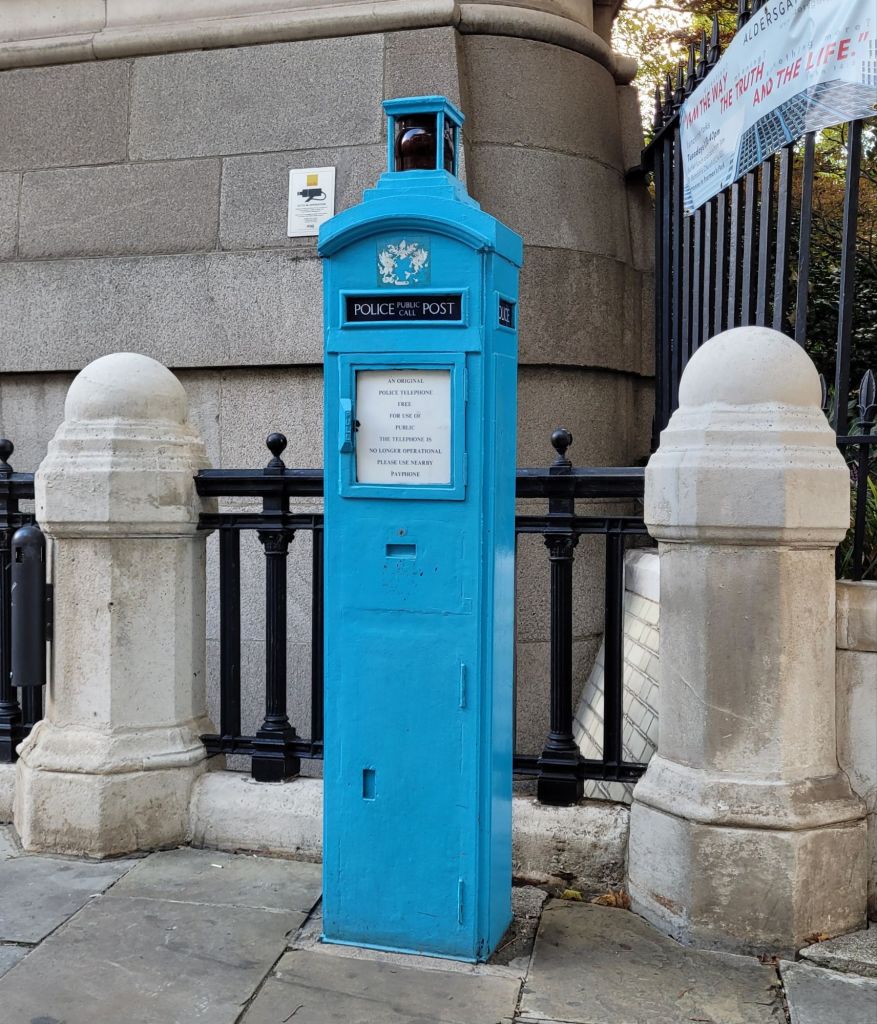
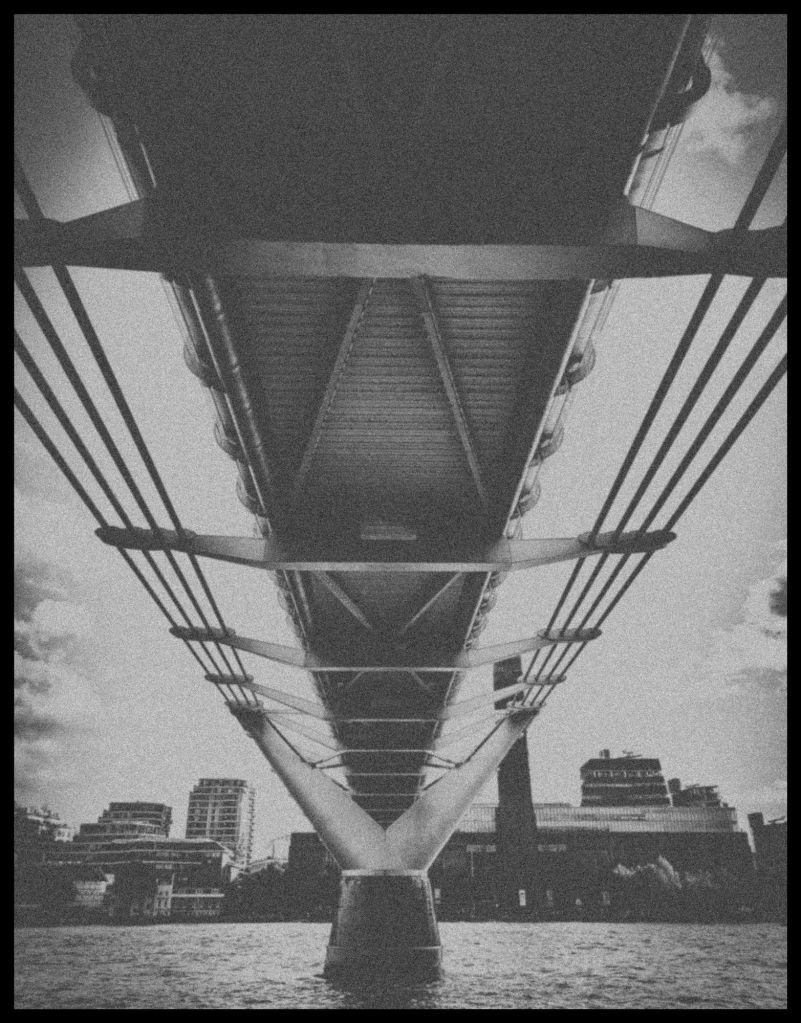
An image showing one of the last remaining Police Boxes in the UK. An image showing the underside to the Milenium Bridge crossing the River Thames.An image showing a gentleman sat at the foot of a statue of Isambard Kingdom Brunel.
Before I commence the entry about my London wander, I would just like to highlight to you the dangers of travelling back home from the smoke in the early evening whilst under the influence. Having purchased a ‘Off-peak return’ ticket from Tilehurst to London Paddington, it didn’t occur to me that I couldn’t board the train at 1812hrs on a Friday evening & had to wait until 1850hrs to enjoy the benefits of being a tight wad cheap rail travel. Doing what any civilised person would do in this situation, I found the nearest boozer & engaged in a few jars with the locals to while away the time. Deciding I couldn’t afford another pint at £7.35 each, I made my way back to Paddington concourse & finding a suitable train of the high-speed variety, perched myself with my headphone dubries on in the very front carriage. With the train proceeding to become full to the gunwhales, I sat back in my jolly comfortable seat knowing that my stop in Reading would be only 20 odd minutes away. Twasn’t long before long the train slid out of Paddington station into the damp, dark evening & I heard, over the top of Big Country by the band Big Country, the familiar automated voice indicating that the next stop was Bristol Parkway. Now, I must apologise whole heartedly to the surrounding passengers if they actually heard me mention the Northern Canadian province called OHPHUCKIT in quite a loud voice at this point. It was a natural reaction considering I was now destined to sit on a train bound for the West Country for a good hour plus before I could undertake a sharp U-turn at Bristol-in-the-rain, to enjoy a similar return trip back of slightly less duration. Oh, how the ticket lady laughed & laughed. Even my own mother enquired if I was going to be passing Andover at some point in the night… (BTW, if you head to t’Instagram you will find actual video footage as I sped past the end of my road bound for Brizzle).
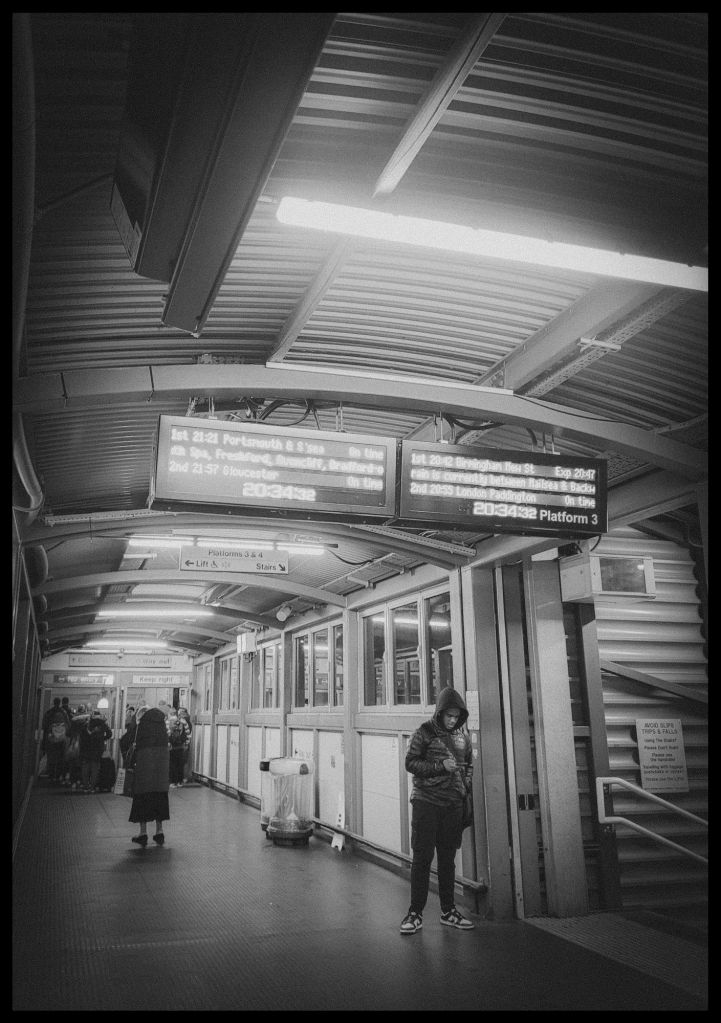
An image showing Bristol Parkway platform, in the rain I might add, at the moment a high-speed train almost blocks my view.An image showing a gentleman observing his mobile device whilst stood underneath an illuminated platform departure sign, inside the covered bridge at Bristol Parkway.
And so many hours before…
Friday 24th October 2025 in the morning
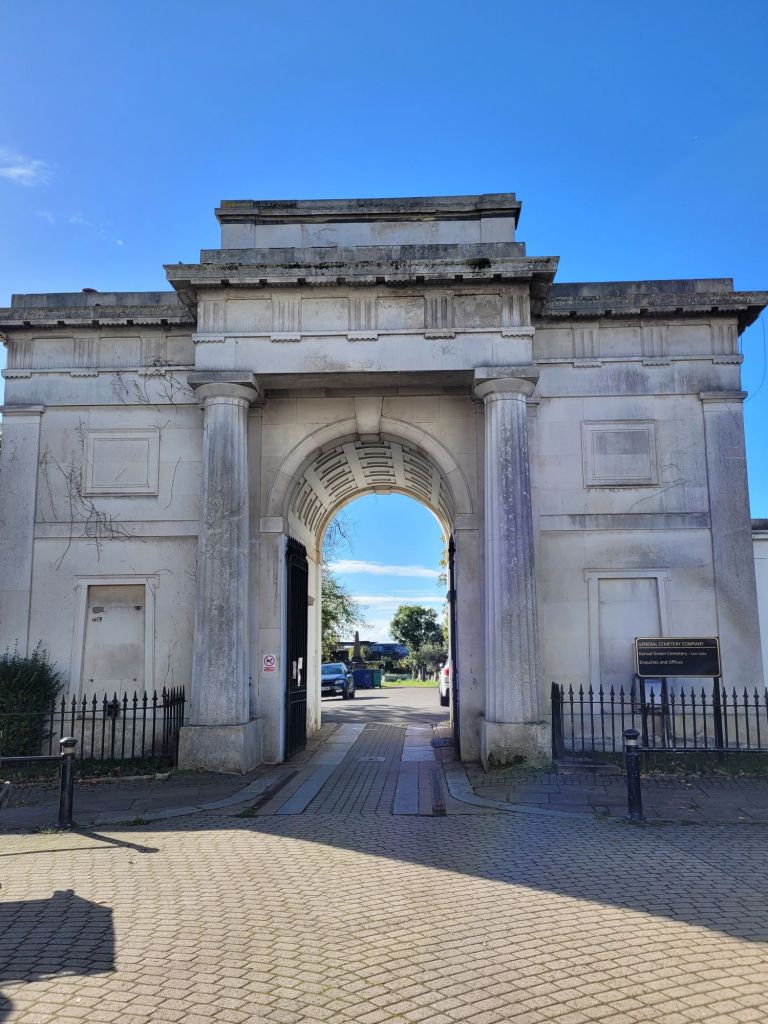
With the sun shining & a sense that nothing could go wrong, I made my way into London for a wander. A place I’d heard of yonks ago was Kensal Green Cemetery which possessed, as I was led to believe, catacombs, those underground ossuaries of thousands of departed Londoners (yes, I had to look that one up as well), which I understood, was well worth a visit. So, boarding a rather spacious & hardly vandalised Hammersmith & City tube train at London Paddington, I shuffled westwards a few stops to Ladbroke Grove (the station), whereupon I wandered up Ladbroke Grove (the thoroughfare) with lots of posh looking townhouses lining the way. After a mile or so, I passed a less-posh Sainsburys & weird looking water-tower/war of the worlds structure thing. Pondering a swift meal-deal I decided better of it & kept going onwards & upwards until I reached the Grand Union Canal, or rather a bridge over it. I knew the cemetery wasn’t far now because I could actually see it from the canal bridge & before long I had honed in on a rather grand, limestone (I think) fluted, pillared archway (I do like a bit of fluting on my pillars) that indicated the way in. Once inside & much to my amazement, I soon discovered that the site was enormous & went on for miles. It seemed that every spare patch of turf had a gravestone or monument on it. And so I walked on & on in sombre silence, observing the names & dates of those over the years have departed this mortal coil. After a little while I ambled along a mausoleum-lined avenue with a seemingly derelict grand pillared (also fluted) building at the end. This was The Anglican Chapel, complete with colonnades, designed in the Greek revival manner by John Griffith FRIBA (1796-1888). I did not know this at the time so after doing some online research & failing miserably, I plodded back to the grand archway with lovely fluted pillars to seek further assistance from the General Cemetery Company, the bods who own & run the place. I must say the lady who dealt with my enquiries was most helpful & offered me the chance to purchase & actually own a small, but perfectly formed stapled guidebook for £6, or for a more modest £20 I could take with me a larger, more comprehensive, ring-bound booklet. Being the skin-flint that I am I choose the cheaper.
An image showing the grand entrance to Kensal Green Cemetery (note the fluted pillars).
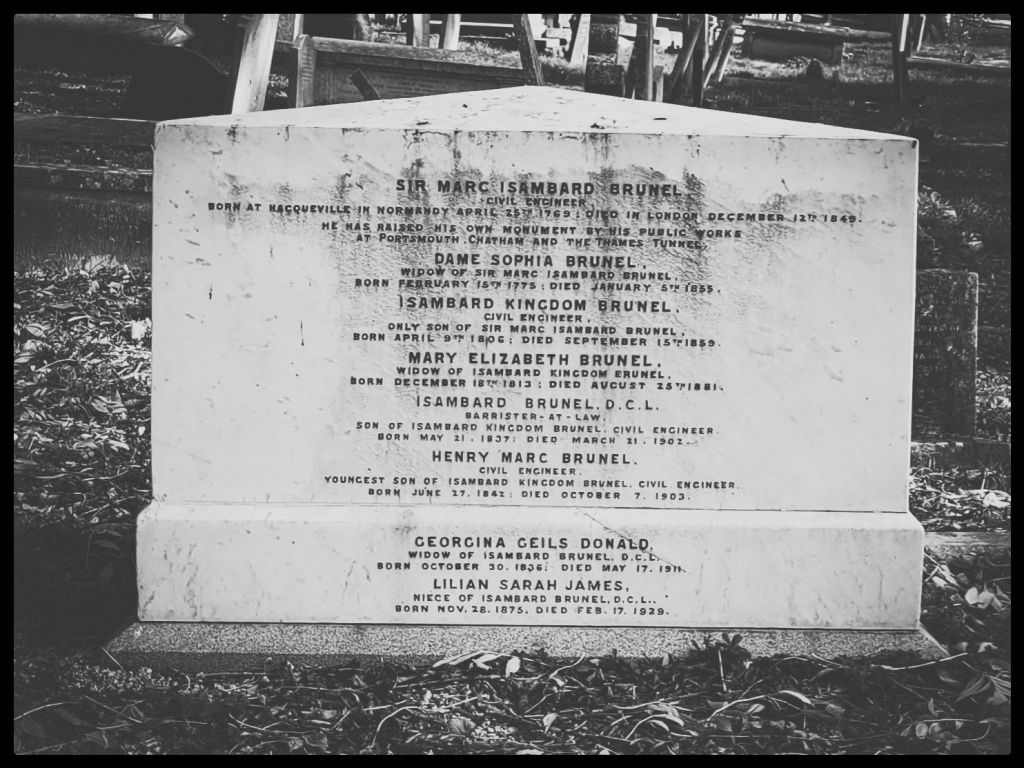
According to my newly acquired concise (stapled) guide costing £6, the graveyard is home to over 250,000 interments from all walks of life & includes: Charles Babbage mathematician, Baroness Byron (Lord Byron’s wife), playwright Harold Pinter, Sir William Siemens co-founder of Siemens, Anthony Trollope novelist, & Lady Wilde, mother of Oscar. Two other personal heroes of mine are the engineer Isambard Kingdom Brunel (1806-1859), & John William Waterhouse, the Pre-Raphaelite inspired artist (1849-1917).
An image showing the gravestone of Isambard Kingdom Brunel & his family.
After a few hours of soul searching in the dead centre of London & finding out that the catacombs are only open on Sundays & with an organised guide, I decided to get back to the land of the living. Turning back towards Ladbroke Grove (the thoroughfare) I was momentarily distracted by a public house, or rather the Brutalist block of flats (the Trellick Tower designed by Erno Goldfinger) somewhat behind it, before I then realised I was standing in the middle of Portobello Road. Ooo, this rings a bell thought I & so I decided to have a mooch around. Before long I soon recalled what this road was famous for as set-up in the middle of the road was stall after stall of people selling all sorts of, well, er, tat (not sure if its tat or tatt, anyway never mind). This instantly reminded me of the Harry Enfield sketch where he is selling ‘crap’ at extortionate prices to gullible yups which brought a wry smile to my face, especially as I was weaving my way through swathes of 20 somethings. Eventually after miles of zigzagging & complete & utter tedium caused by looking at ‘crap’, I ended up at the end of Portobello Road & proceeded into that well-known tourist hot spot, Notting Hell, sorry, Notting Hill. This I knew instantly as as every business proudly displayed it on the front of their premises & on jute bags & cuddly toys & any other bit of merch you could possibly think of. Personally, I’m just biding my time waiting for Richard Curtis to write a film called ‘Tilehurst’ & then I’ll be quids-in selling all the Tilehurst branded tat I had made in China a few years back. Bizarrely, it was around here that Frank Skinner (a comedy person) bumped into me which brings the tally of famous people bumping into me to a grand total of 3 this year, the others being Wayne Barnes (a former rugby referee who bumped into me at Lords Cricket Ground) & Ewan McGregor (an actor & motorcycle enthusiast who bumped into me at the ticket gates at Tottenham Court Road Tube Station). I do love that bewildered look I get from famous people when they look at me & wonder where they’ve seen me before..
An image showing a street sign saying ‘Portobello Road, W.11’.
An image showing the delightful entrance to Basingstoke shopping centre as viewed from the train station.
Located in the northern reaches of Hampshire, the market town of Basingstoke has had a long association with history, having been mentioned in the Doomsday Book (currently unavailable on Amazon) as being ‘a market town’. According to my in-depth research undertaken just a moment ago, the name Basingstoke refers to a settlement of an Anglo-Saxon tribal chief who went by the name of Basa, which I do believe is short for Barry. Further online analysis has identified that artefacts from a Neolithic campsite (possibly without electric hook-up & Elsan waste disposal) have been found on the outskirts of the town. Moving forward in antiquity, the remains of an Iron Age settlement known as Winklebury Ring was discovered. Although sounding like a rather sinister medical condition (‘I’m sorry to inform you sir that you have a rather nasty case of Winklebury Ring.’), such is the need to instil the history of the place into young minds that the site of great importance was bulldozed & a school built in it’s place. When it comes to road links though, over the years many historic routes have passed through the area. An Iron Age (maybe Stone age) route known as The Harrow Way (The name believed to of been a forerunner to the famous Cockney song The Lambeth Walk – ‘Doing the Harrow Way, oi’) connected Seaton in Devon with Dover in Kent, whilst a Roman road called Roman Road was built by the Romans & connected Winchester with Silchester. In the reign of Queen Elizabeth II though, a further trade route known as the M3 was added, connecting Basingstoke with London & the Southern coastal city of Southampton.
Adding great historical importance to the town (& a great deal of resale value to the properties within) is the nearby village of Old Basing. Firstly, it was here that King Æthelred of Wessex and his brother Alfred the almost Great (later King Alfred the Great) received a bit of a lambasting from a marauding army of visiting Danes in 871, & secondly, in the English Civil War (1642-1646) the area became home to scores of, um, soldiers I think. Apologies, I seem to have bored myself whilst researching the subject.
Anyway, advancing onwards once more through the annals of antiquity the town became linked with many industries in the 18th – 19th Century. Machinery manufacture with Wallis & Haslam (later Wallis & Steevens) & Thornycroft being large employers of their day, whilst May’s* Brewery was well appreciated. *anyone interested in the grand old game of cricket, the brewery owner, Mr John May, purchased a piece of land destined for development & rented it at low cost to Basingstoke Cricket Club, hence the name of the pitch is forever known as May’s Bounty. Another character of note that literally set up shop in Basingstoke in 1856 was that of Thomas Burberry, the fashion designer & founder of the international brand of Burberry. Famed for his invention of Gaberdine, his legacy still lives as clothier to many, er, upright & well-healed young persons in this country.
Arriving in Basingstoke Railway Station on a Friday morning at about 1103, having previously assured the management that I was going to be spending the day undertaking Compulsory Professional Development training at home on the computer, my keen eye immediately surveyed the railway structures on the platform. According to something I think I read onetime on t’internet that although some parts of the station still actually exist from the 1855, such as the canopy on Platform 4 & maybe a sausage roll in the station café, the remainder of the station was actually constructed in 1903, & followed a design by a Mr Jacomb Hood in a pattern similar to that of others along the London & South West Railway Line. So, while the masses descended the stairs, rebelliously ignoring the international laws of railway staircase etiquette by going down the up side, I spent a few brief but thoroughly scintillating minutes, inspecting the platform for anything remotely interesting. Finally, after staring geekishly at some cast iron downpipes & metal railings that displayed 1.25 centuries & possibly 1.25 inches of congealed paintwork, I admitted defeat & descended the stairs, to proceed through to the essential modern glass & steel monstrosity that was bolted on to the front of the old station.
Resisting the urge to throw my arms aloft & scream at the top of my lungs ‘Good Morning Basingstoke’ (thus mimicking the song ‘Good Morning Baltimore’ from the musical Hairspray), I contained my inner Tracy Turnblad & simply ambled over to the top of some steps to look down onto a gaggle of smoking mothers with their prams, scent marking the entrance to Basingstoke retail centre (called ‘The Malls’). Not possessing the urge to buy a vape, Turkish style haircut or some dubious food of mass production, I avoided the town centre for the time being, & undertaking a crisp left turn I marched-off in a smart & soldier-like manner in front of the older railway buildings. Now for those who enjoy snippets of Sorbid & Morbid (I think I can safely refer to this as S&M) history with their eggs in the morning, as well as the Provisional IRA leaving a bomb in the station toilet in 1993, which thankfully didn’t detonate, it was at this very taxi rank in 2001 that a mutilated body was found within a suitcase, having been placed there by a Sri Lankan Buddhist monk. The peace-loving monk apparently had a disagreement with a fellow Sri Lankan & decided to chop him up with a meat cleaver. Cheerful stuff, eh? Cautiously passing by a line of taxi cabs & keeping a watchful eye out for anyone in orange robes wielding a meat cleaver, I eventually came face to face with one of the last remaining old pubs in the town, The Queens Arms. Although, it is beyond the remit of this article to comment on the quality of the produce or the friendliness of the clientele, at the time of writing, I ranked the establishment as ‘Potentially Interesting’ as I didn’t actually enter into the place as it possessed a slight whiff of being a local boozer for local people & one that oiks like me visiting from Reading may have been stared at within.
From the Queens Arms, one may turn on their heels & run like buggery back the station having a complete change of heart, or they could do as I did & follow the thoroughfare in a downhill direction passing by a number of former high-rise office buildings which have been lovingly converted into high-rise living accommodation. Not far beyond these, I happened to observe a large, somewhat skewed building on the left-hand side which resembles a sort of modern church/concert hall. This large, somewhat skewed building, as I soon discovered was not a modern church or concert venue, but a discreet Waitrose supermarket, subtly identified by their massive green logo on the front. I also discovered that said supermarket of the middle classes will set you back a whole £5.00 for their 3-piece meal-deal, a price substantially more than Tesco’s at £4.25 & far superior to Sainsbury’s cheap & cheerful offering at £3.90. Another equally valid point worth mentioning is that although there are several benches available outside the store entrance, the view is somewhat poor & in hindsight, maybe not the best place to fire up the brew-kit for a lunchtime cuppa.
With the famous quote ‘when going through hell, keep going’ lodged deep in my consciousness I advanced furthermore downhill & under the underpass & over the overpass that is the pedestrianised centre of a large roundabout & modern amphitheatre/skateboard park, towards the base of Eastrop Lane. Casting my learned eye eastwards along the line of multi-storey commercial buildings that make up Alencon Link, I spied Fanum House at the very end. This building was the first of a high-rise nature in the town & was officially opened by Queen Elizabeth II in 1973 to be the official residence to the Automobile Association. At this point, should one feel the need to have a closer look at this structure, one may undertake an additional amble through Eastrop Park which runs parallel to Alencon Link. (Authors note: Under the ‘c’ in Alencon is one of those French squiggly jobbies which looks a bit like the number 5. Being unable to find it on my keyboard, & as I am not actually French, I cannot be arsed bothered adding it).
Now, progressing in an uphill fashion along Eastrop Lane I passed by the Church of St Mary on my right-hand side, which according to Historic England has aspects dating from 1774, with further aspects added in 1886, 1912 & 1969. Their website also mentions that within the church there is a slab tombstone dating to 1663. From my own observances though I spotted an immaculately maintained war grave indicating an RAF pilot who died during the Second World War.
Reaching the summit of Eastrop Lane, I momentarily considered aiming my person in a diagonal bearing up & onto Crossborough Hill, the location of the famous Costello School (formerly Harriet Costello Comprehensive School). This fine educational facility possesses a select & distinguished alumni such as Elizabeth Hurley (the former punk, safety pin enthusiast & actress), Tom Rees (the rugby player) & a rather dashing & extremely humorous blog author, the name of which momentarily escapes me. Instead, I hung a right onto London Road, pausing momentarily to observe the White Hart Public House (Potentially interesting once again). Reputed as being the oldest in the town (built circa 1600) & boasting a fine 4.1 stars out of 5 on Facebook, I decided that although I hadn’t had a pint in there since my third year, I’d give it a miss & carry on with my excursion.
Just up a bit from the oldest pub in town (reputably) is the town’s War Memorial, a Grade II listed monument, complete with angel on top (Interesting) which lists the 1200 local men who served in the 1914-18 Great War. Behind this is the War Memorial Park, which comes complete with a bandstand, large bird cage (it may not be there anymore) & small, white hexagonal building that, according to local rumour, serves no function whatsoever. After an in-depth analytical search on t’internet, some bloke on Reddit says it was probably an ice-house for the Goldings Building (the posh looking building situated next to the War Memorial itself) which was owned by Mr Burberry. Anyway, assessing the locale for weirdos & winos, I secured temporary occupation of a park bench & partook in another brew.
End of part one
Part Two Carrying on
Located not too far from the War Memorial Park is an impressive educational facility called Fairfields Primary School. This structure with its own haunted bell-tower was built in 1887 & over the years has educated 1000’s of local people. One rather famous name that attended the school briefly was that of Ruth Ellis, who later gained notoriety as being the last woman to be hung in the UK. Another was a rather devilishly handsome blog author, who gained notoriety by being one of the last to receive capital punishment from the headmaster, Mr K. Goulden. At the time, December 13th 1981 at 2.15pm to be precise, although his counsel protested that the lad he was aiming at had actually ducked & ‘she was at the wrong place, at the wrong time M’laud’, he was subsequently found guilty of launching a snowball at high velocity towards the facial region of a dinner lady & was therefore duly sentenced to 3 whacks with a size 10 Dunlop plimsol.
I decided not to visit the school on this occasion (obviously due to past trauma issues) & instead headed back to London Road, whereby I eventually passed, like a prodigal son returning from a campaign in distant lands (not sure Tilehurst counts), most triumphantly through the modern metal Triumphal Gates (Interesting) that according to some official blurb about art from Basingstoke Council, ‘herald the entrance to the town centre’. Awaiting the cries & cheers of adulation from the locals, all I got was a monosyllabic grunt from a woman smoking weed who begrudgingly moved so that I could take a photo of it for the ‘gram’. What was more interesting than the gate or the weed woman was an adjacent terrace of old houses called ‘Deane’s Almshouses’ (Interesting). These abodes for the poor & infirm were constructed in 1608 courtesy of a generous gift from Sir James Deane, a merchant adventurer who made a decent wedge from trade in India & China. Rumour has it that an elm tree was planted nearby to commemorate Guy Fawkes attempt at blowing up the Houses of Parliament, but it grew to such ‘a monster’ (a real quote) that it became a hazard to stagecoach drivers on their way to staging at The Red Lion Hotel almost opposite, that it was later cut down..FMTI.
I would just like to state at this point that I am not a fan of retail areas, especially shabby ones, & as identifying as ex-military, whenever I am up close & personal with crowds of people, my dickhead sensor goes into overdrive. So, with my eyes narrowed on the lookout for thieves & vagabonds, I crept cautiously past the tattoo shops & tat shops & shuttered clubs & bars that identify the Top of Town (honestly, the powers that be have actually called this area ‘the Top of Town’) towards Market Place.
In this area there are two buildings of note. Firstly, the grand-looking Town Hall building (circa 1831) complete with Tuscan porch with 2 column pilasters & a balustered parapet, which these days houses the Willis Museum (potentially interesting), & secondly, just behind McDonalds & up the little alleyway is the public toilets (Extremely interesting). Now you might be asking to yourself, why has he mentioned these, well put it this way my dad designed one of them.
With my attention & sense of humour seriously waning, I decided to call it a day & head for the hills. From Market Place I wandered down Wote Street passing the Haymarket Theatre, but at the bottom as I was just about to enter the urban battlefield which is Festival Place, I spied something, something that tickled the highly childish & juvenile corner of my brain. This something was almost 3 metres high & weighed in at 7 tonnes & resembled a, um, a massive, giant, enormous, carved stone, er, penis. The Church Stone (Interesting) is actually quite a rather splendid sculpture that was commissioned to commemorate a church which was previously located on the site, which just happens to look very much like a gentleman’s appendage. And with that, if I can give you any genuine reason to come & visit the town of Basingstoke, it would be not to immerse yourself in the rich history & culture (sadly that has long since departed), it would be to come & stand & have your photo taken next to Wote Street Willy.
As a gentleman of a certain age, I must admit that I struggle to understand much about modern society, especially things like pronouns & gender identification. When I hear of people referring to themselves as ‘they’ & ‘them’, or others who identify as a ‘cat’ or a ‘frog’, it does seem rather weird to me. But as a dear friend pointed out to me not so long ago, that as a child I was always ‘a little bit weird’ myself. Although I could of become #offended, burst into tears & storm off in a hissy fit, I took the comment as a compliment. With my logic, possessing a character that is weird, geeky or even eccentric, as I prefer to call it, is a celebration of individuality. It is very much about being unique.
The thing is, is weirdness essential for the continuation of the species? Or are we destined to become a civilisation of robotic clones? And forget the Romans & the Greeks, where would we be without the eccentrics & the geeks?
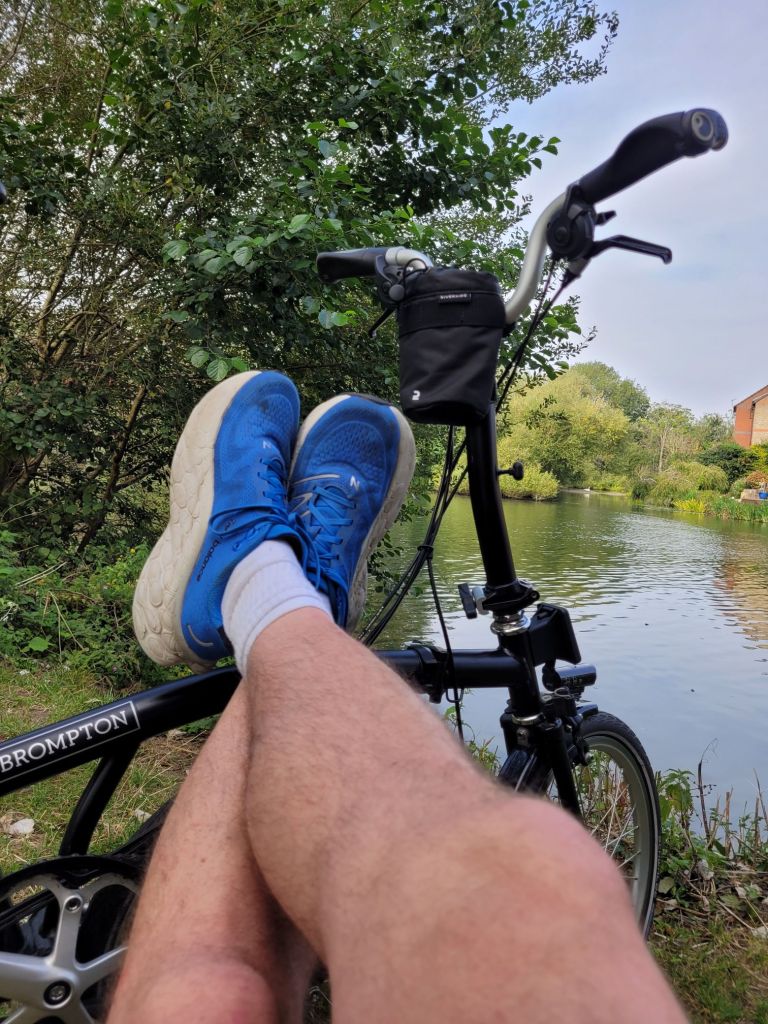
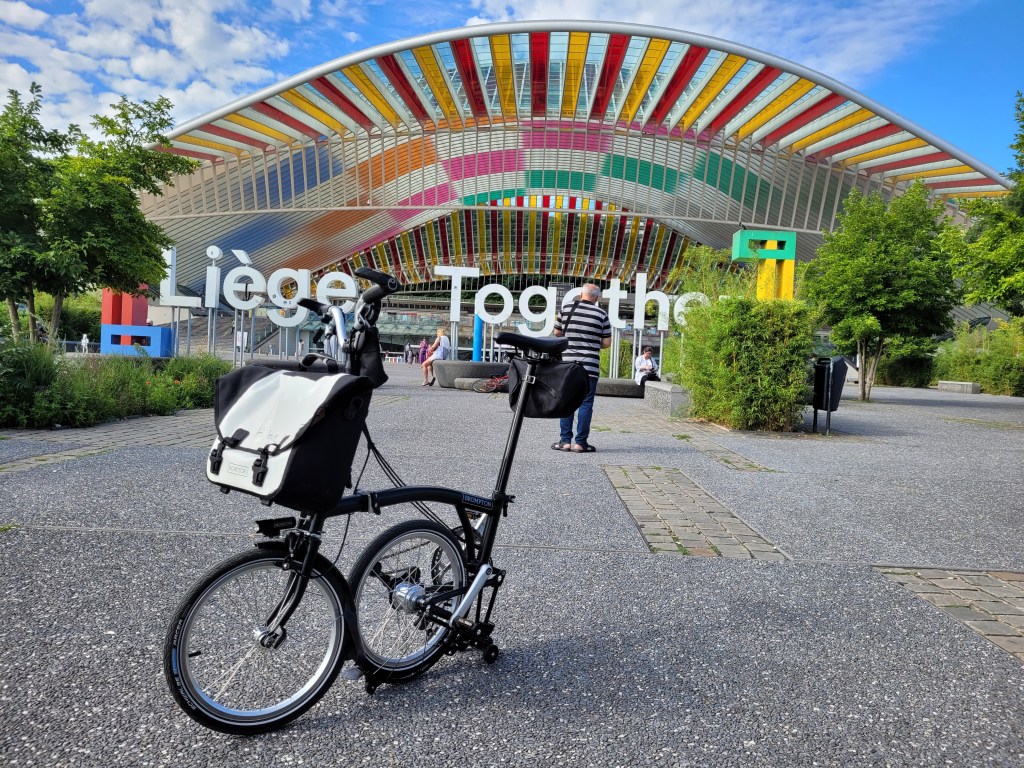
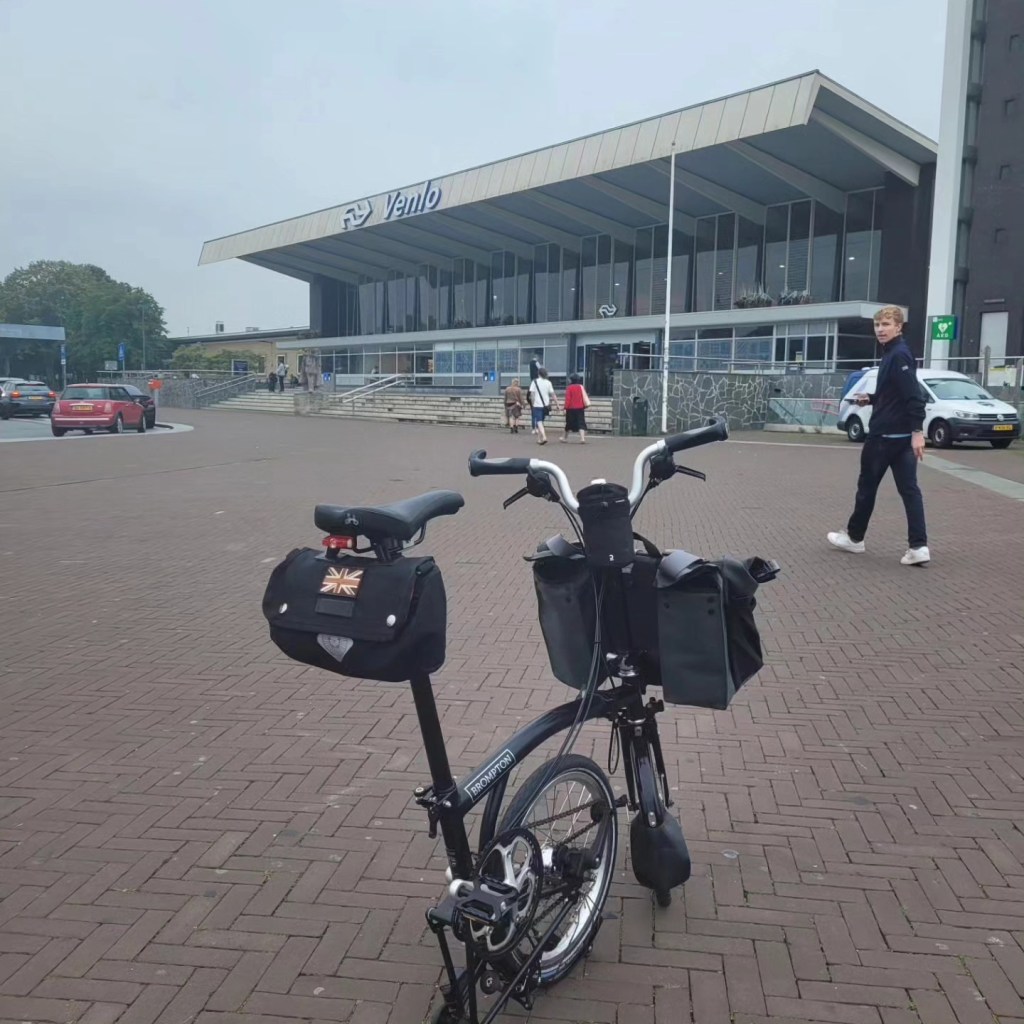
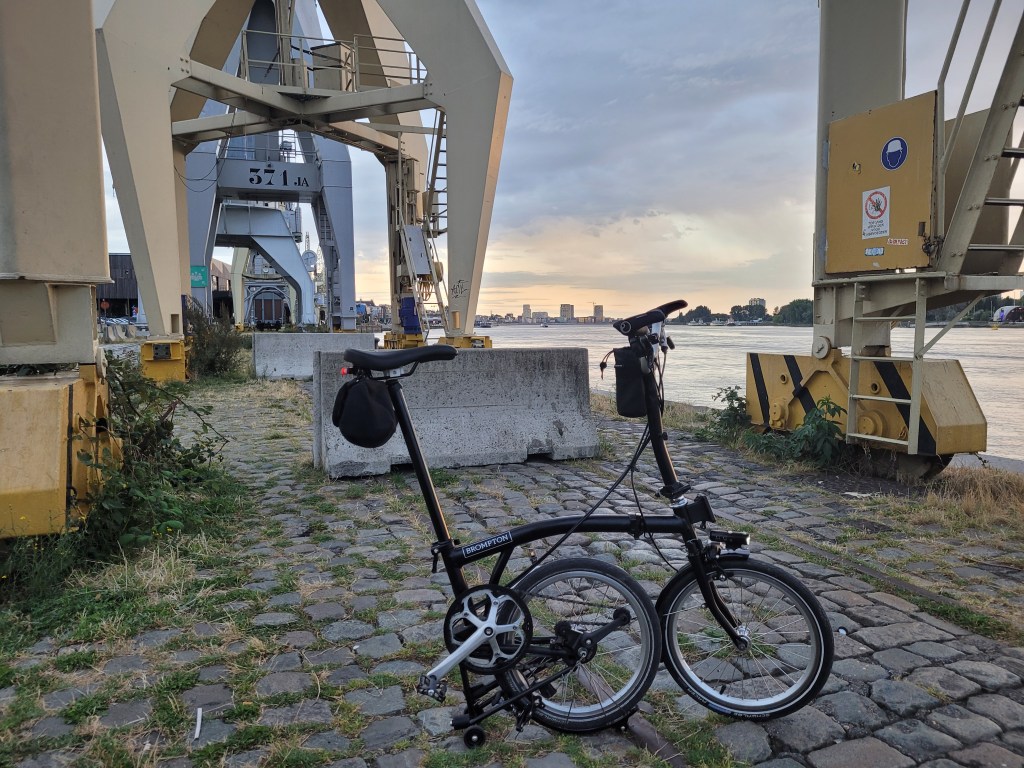
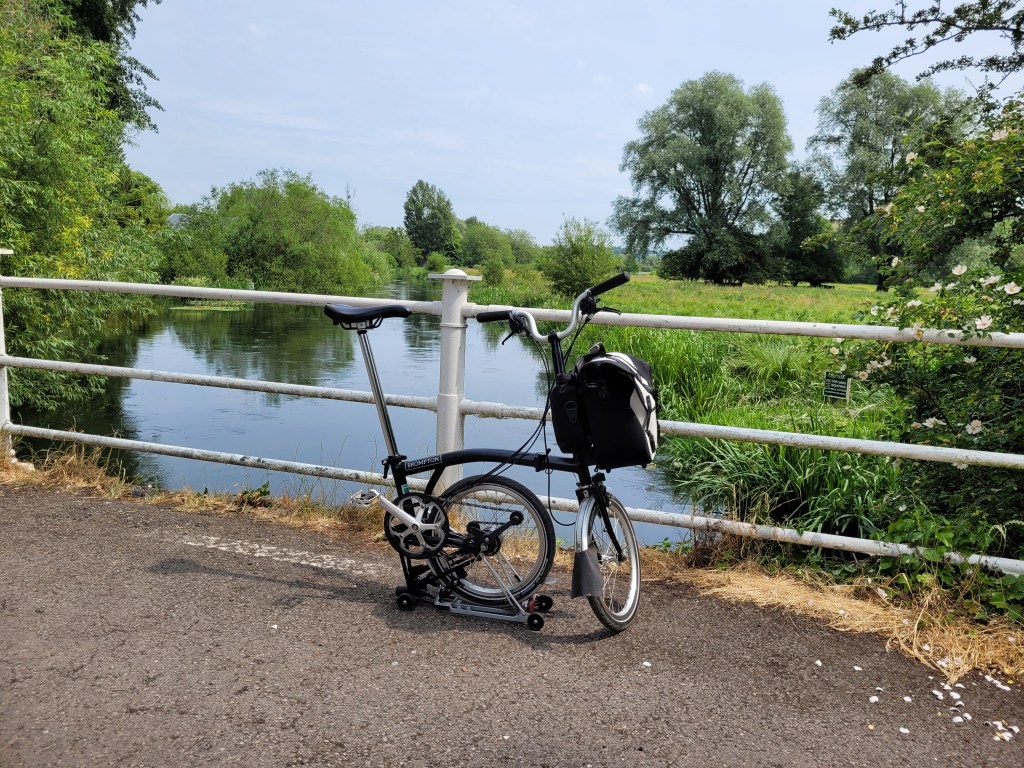
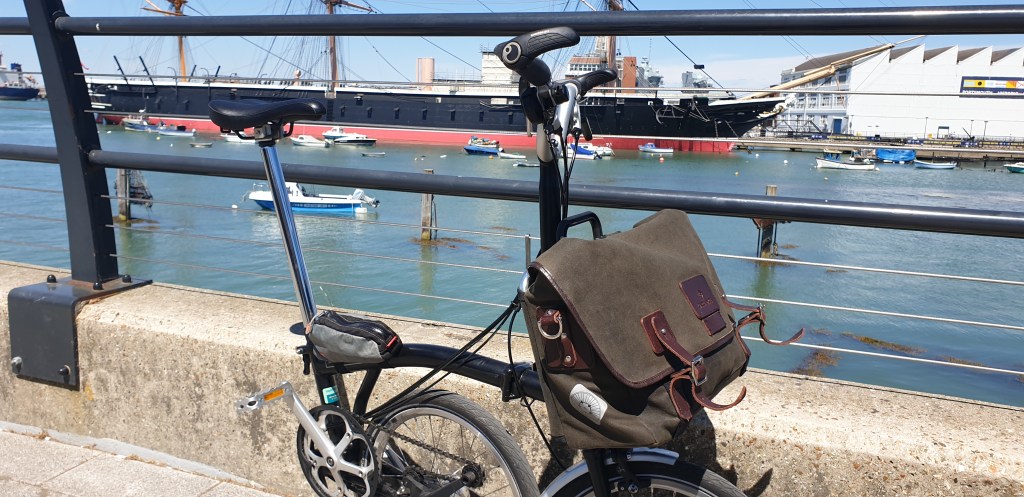
Now, it shames me to say that prior to 2018 that I was indeed a ‘smirker’. I was one of those smug, self-righteous sorts, who upon viewing a gent or lady perched upon one of those popular, diminutive-wheeled, folding bicycles, would carry upon my fizzog what could only be described as a wry & condescending smirk. But such was my ignorance, & frankly juvenile attitude, that at the time I failed to comprehend the sheer practical magnificence of this fine velocipede. So what changed my mind, I hear you ask. Well, it was during an outing to Tenby with my eldest, that I spied a gent & his companion disembarking a train with what looked to my untrained eye, like a pair of folded wheelchairs. But as I watched on from the carriage somewhat perplexed, within what seemed like a matter of seconds, the pair had unfolded not a pair of wheelchairs, but a pair of rather nifty Brompton bicycles.
Over the weeks that followed, I began to think more & more about the functionality of this uniquely portable bicycle. One day, I decided to pluck up the courage & pay a visit to my local bicycle retailer. Upon entering the premises, I aimed myself towards a bushy-bearded, check-shirted, tattoo-armed hipster chap who was stood standing behind a counter, tip-tapping on his handheld device. After what seemed an age of me faux-coughing & flapping my arms about trying to gain his attention, the hipster chap eventually managed to provide me with a whistlestop introduction to the Brompton bicycle. As well as showing me ‘the fold’ numerous times & making sure that I was well aware that of the ‘maximum rider weight limit’ (Cheeky young whippersnapper), he actually permitted me to take a model for a spin. Well I must say, despite being a tad twitchy with it’s teeny-weeny 16 inch wheels, the Brommie was rather delightful, so much so that the next day, after consulting with the management indoors & obviously hacking off an arm & leg to pay for the blasted thing, I went online & ordered one of my very own. Following what seemed to be like an eternity (about 3 days) I finally had the message that my brand-spanking new Brompton was ready for collection, & with an excitement of a nipper on Christmas morning, I excitedly skipped-off to the bike shop to collect my new plaything.
Well, it was love at first sight. From the off I showered her with expensive gifts & the odd cosmetic enhancement – countless bags, a black seat post, some swanky pedals & a pair of nifty ergo grips. Although I may of had many countless other bikes in the past, I can honestly say that Brom was the best ride of my life. I found that when I got my leg over & was in the saddle, so to speak, her upright position encouraged me to not rush & to just take it slowly & leisurely, rather than grind it out, all hammer & tongs. With her, it was all about enjoying the journey – a perfect match for a chap like me.
Although we hooked up back in 2018, Brom & myself have had many adventures together (as well as countless visits to the local pub & back), would I recommend a Brompton to anyone? Most certainly I would. They are far from cheap & they have their own peculiar quirks, but in this age of dull & boring Bromptons are just great fun. Oh & should you see a rather portly chap wobbling along on a rather small-wheeled bike anywhere near Reading, don’t be a smirker. Smile, wave & say ‘what-oh chum’, as it may just be me.
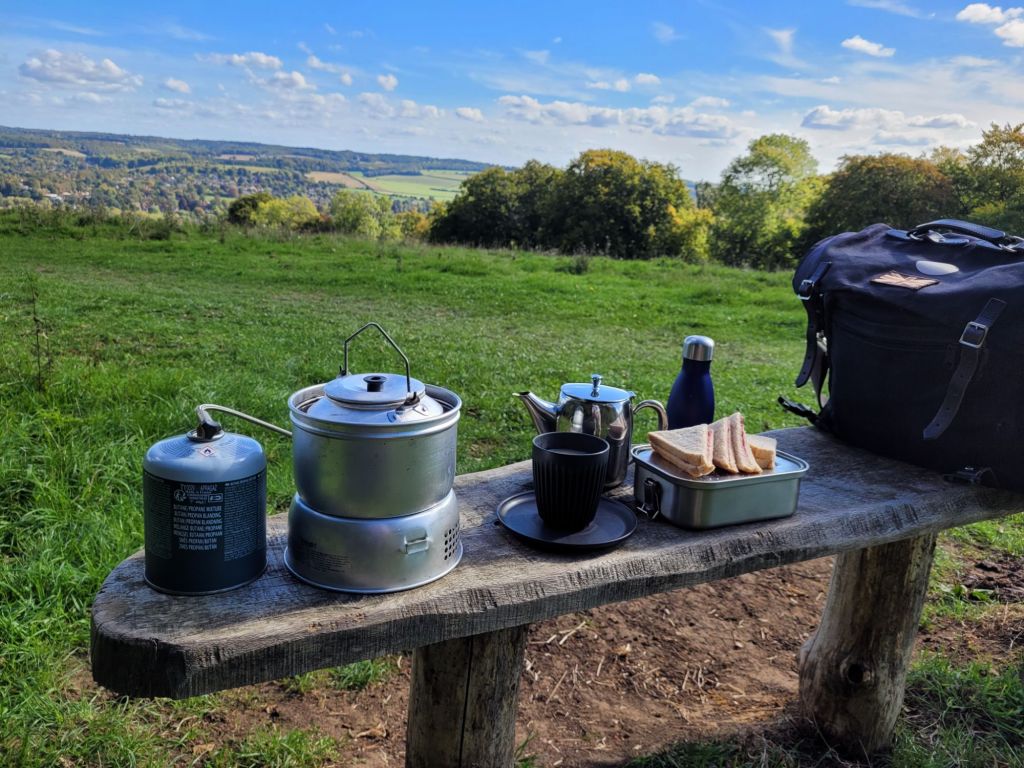
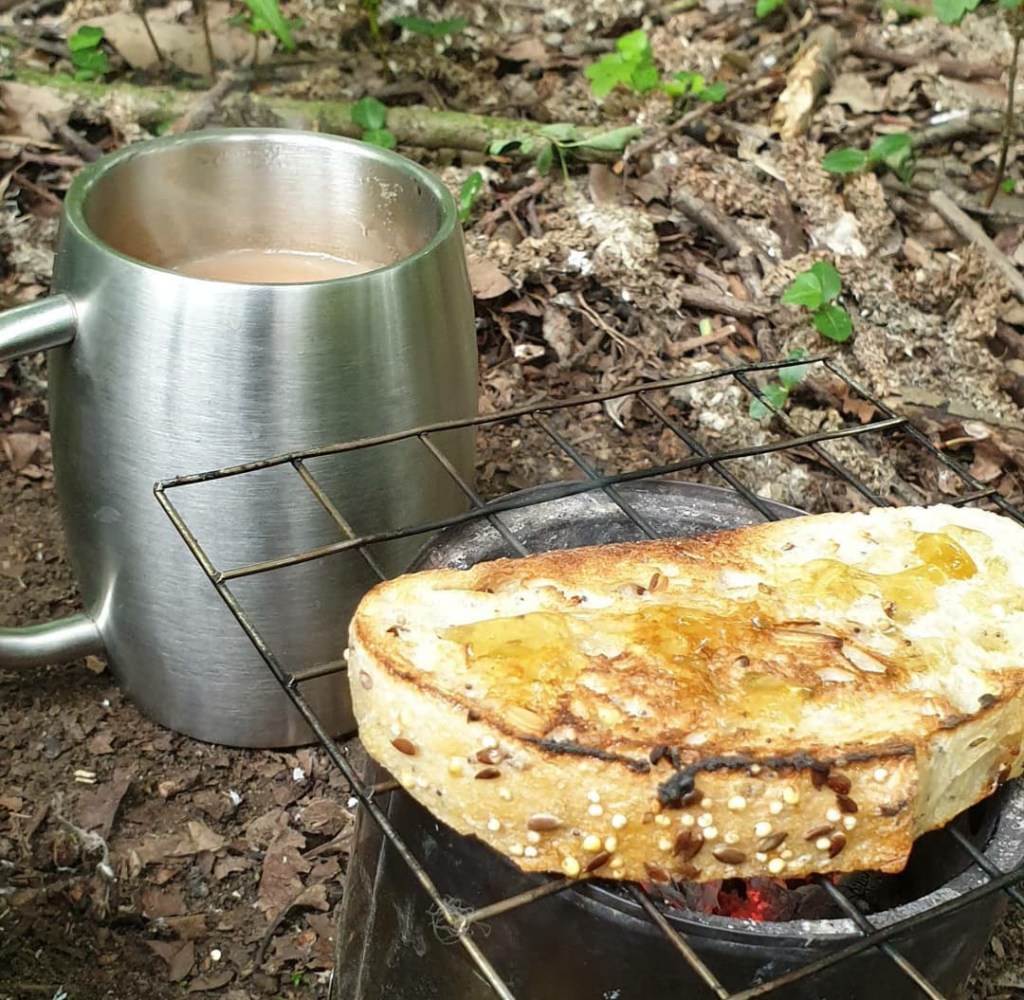
Being a former member of Her Majesty’s Armed Forces, many centuries ago I might add, I understand that there is one thing that adds joy & merriment to life, especially when you are cold & wet & thoroughly pished-off. That thing is beer. No sorry, I mean tea. Definitely tea & not beer. A cup of steaming hot, tea.
Since the First World War, the ability for a soldier to rustle up a ‘brew’ (a hot cup of tea or other hot drink) whenever & wherever is a skill that is first taught during military basic training. And it is a skill which gets honed from that moment forth.
But why do we squaddies hold the humble brew with such high esteem? Well, besides the obvious instant hit of warmth & rehydration, the act of stopping & setting up a stove & then waiting for the kettle to boil, although not quite as Zen as a full-blown Japanese tea ceremony, offers a little respite from whatever shenanigans you might be involved in, providing the perfect opportunity to pause, take stock & simply CTFD.
Just like my days in uniform I like to use tea making as an excuse to pause and CTFD. It maketh no difference whether I am out on the hoof or out in the back garden, taking time to stop and make a brew is never time wasted. It is a time to stop the mental cogs from spinning and to focus on the important things in life, like ‘how many rashers does it take to make the perfect bacon sandwich?’ and ‘is it wrong to eat a whole pack of dark chocolate Hob-nobs in one sitting?’.
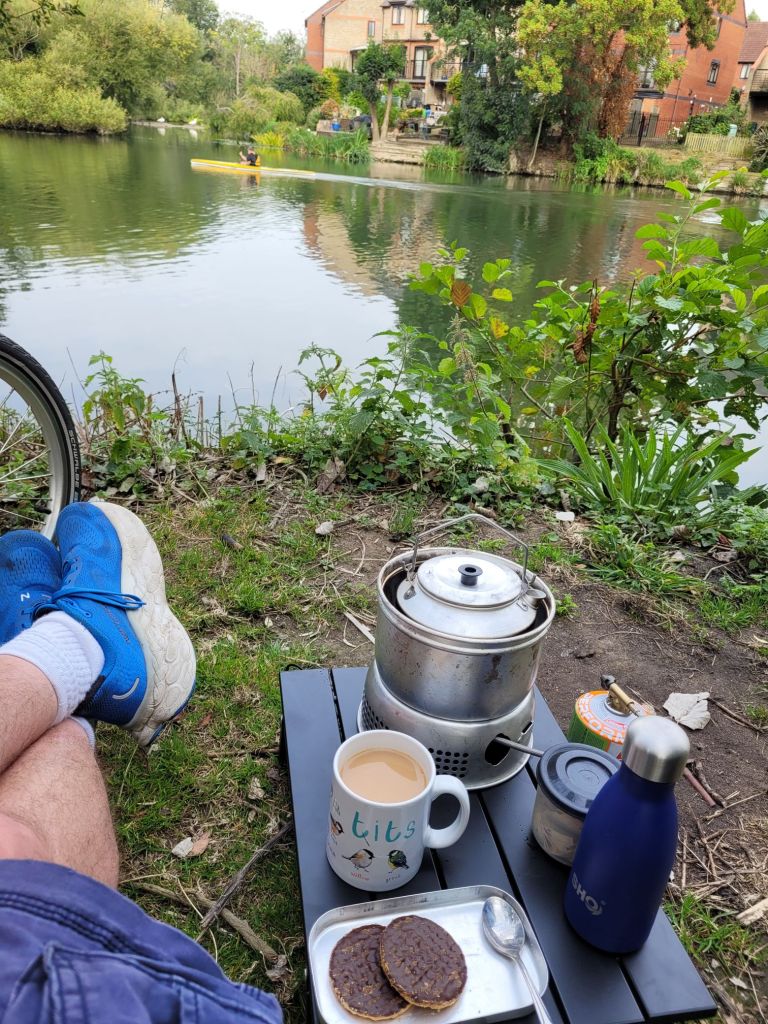
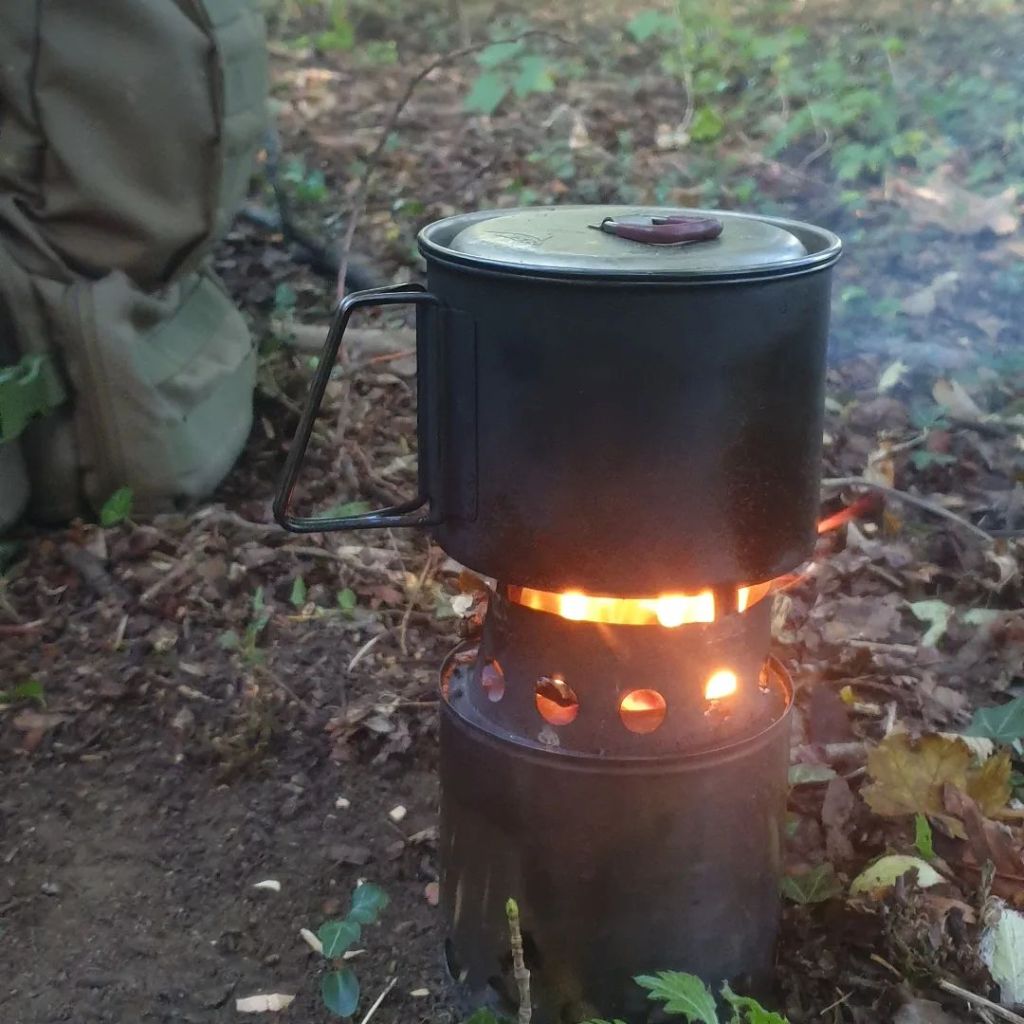
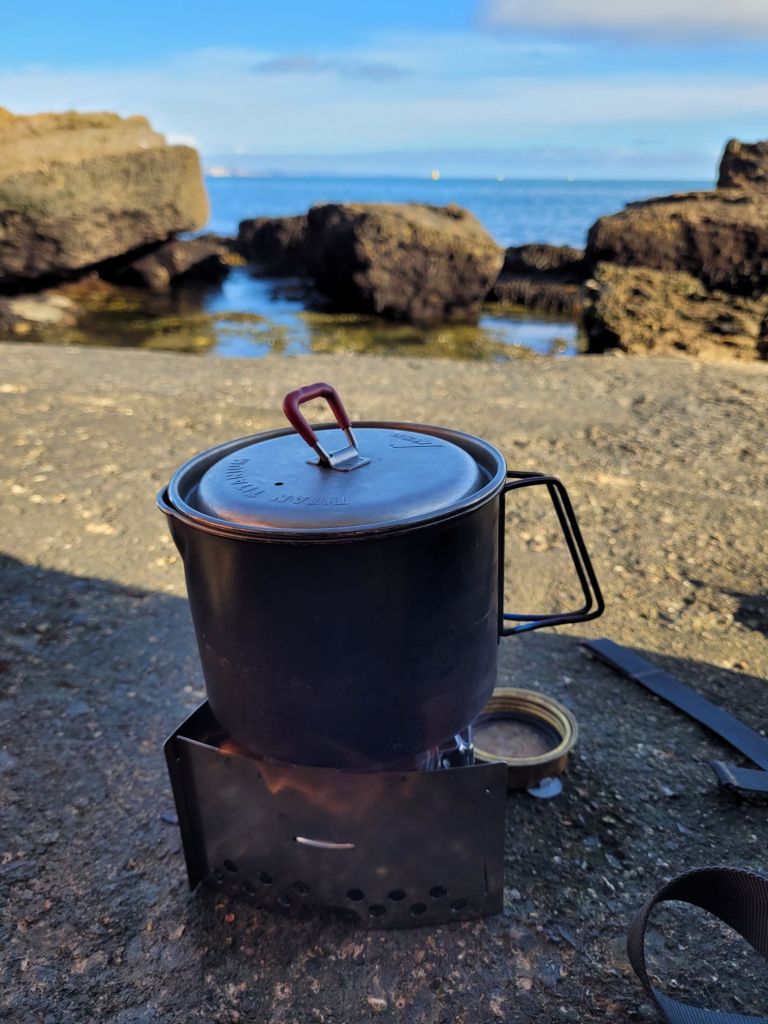
The image shows a small table upon which is a Trangia stove, a cup of tea (& other tea-making accoutrements) & selection of dark chocolate Hob-nobs. It also shows a pair of rather handsome legs.An image showing a blazing Bushbuddy stove with an MSR titanium kettle perched on top.
That initial escape from Dortmund to Frankfurt gave me the confidence to go on adventures further afield & over the next couple of years, I forayed all over Germany by train. I went to Kiel in the north, to München in the south, to Hanover in the east & to Köln in the west – I even went to Zeebrugge, which was a good 8 hour trip, just to try some Belgian waffles. In fact I was sat in the station café in Zeebrugge when it was announced that the Berlin wall had fallen. And If I ever hear David Hasselhoff singing ‘Looking for Freedom’ again.
My bimbles increased dramatically when I then got posted to Berlin though. Following the 1948-49 airlift where British forces helped the West German population get vital food & aid, the Berliners agreed as a thank-you, that all Allied personnel were to be given free travel on public transport within the city, an act that was still in operation until the last troops left in 1994. So when I arrived in early 1992, I found I had a massive city full of history to explore & all for free. I remember looking at a map of the city on a wall at Spandau U-bahn (underground) station & wondering where do I go first. I studied the indexed list of stations, like a gambler would study a race list, in the hope a name would suddenly leap out at me. One station always did – Schlesisches Tor. This was mainly for the fact that the more I tried to pronounce it, the more I sounded like a very drunk Sean Connery. Before long, I soon discovered that the Zoologischer Garten was always a good place to aim for as the Kurfürstendamm, was just around the corner. The Ku-damm, as it was known to Berliners, was full of trendy designer shops, hotels, bars & restaurants, which was always worth a bimble, day or night. As my knowledge expanded, I started to use the S-bahn (overground train) to skirmish into East Berlin. Although the wall had only been down a few years, the huge act of modernising the city was well underway & it was sobering to see that so many buildings still had visible scars from the Second World War.
Eventually my army career drew to a close & although I left Germany behind, my enthusiasm for bimbling did not diminish. To this day I still get seduced by departure boards in railway stations & I still cherish sitting on a train, with my headphones on, just staring at the scenery out of rain-splattered windows. In a world that is so obsessed with connectivity & living life at warp-speed, the need to shut down the laptop, leave the phone behind & just go for a bimble, has never been more important. I would urge anyone to try it.
Although there are a multitude of answers to the particular question of why? such as, because they are there, because I was frightfully drunk, & because the sheep had lovely eyes, the reason I have posed this question as a title was to give you an insight into why I started this blog. So, here it is.
As a youth, it was highly evident that I was operating on a physical level somewhat below that of my peers & although somewhat average at school rugby, due to my being big-boned, sport by & large was not really my forte. So, when it came to actually leaving school & getting a job, naturally I drifted into something befitting my laidback character – I joined the British Army. Now I know what you might think that the military is no place for someone like myself but you are wrong. In my experience there are 4 types of characters who join the British military. Firstly, you have those who are very keen & soldiery & actually enjoy doing their day job (known as ‘the professionals’). Secondly, you have those who have had frequent skirmishes with the law & consider the forces to be an alternative option to prison (known as ‘the dodgy f**kers’). Thirdly, there are the plain out & out fruitcakes who have decided that a life in the services offers substantially more perks than a life in Broadmore (known as ‘the psychos’). And finally, there are those who join in search of ‘travel’ & ‘adventure’, as proclaimed by the Army Careers Office (known as ‘the gullibles’). I fell very much into this latter category.
Admittedly during basic training, the Common Military Syllabus for Recruits as it was formally known, I must say that there were multiple episodes of miscommunication between myself & my instructors, especially when it came to anything remotely physical. For some strange & unfathomable reason my troop sergeant, let’s call him Sergeant S, took an instant dislike to me. I just seemed to niggle him. Now the most logical thing to do in this situation would be to keep one’s gob shut & stay well out of his way, I, er, found it quite entertaining to, er, bait him (Children, do you know what it’s like to run around a parade square lots of times with a rifle held above your head? I do). Eventually after a year of fun & games, & much to everyone’s surprise (not least Sgt S), I blagged my way, sorry, I mean, I finally passed out (not literally) from borstal the Junior Leaders Regiment Royal Artillery. Everywhere where right & glory lead & all that….
And so, that is how on the evening of September 6th 1988, I found myself stood standing in the pouring rain outside some large metal gates waiting to be let into my new adult artillery unit, by two large un-metal squaddies in the beer capital of Europe, Dortmund, West Germany.
For a while I loved it. It was one big adventure. But it wasn’t long before I became jaded with the bullsh*t. Ask any squaddie who served between 1660 & 1995 what the worst bit of army life was & they will undoubtedly say ‘all the f’king bullsh*t mate’. But what does this delightful term refer to, I hear you cry. Well, bullsh*t (I will abbreviate to BS for sake of having to keep finding the asterisk key) is basically all the fuquittery that one has to endure on a daily basis irrespective of whether you are in the Paras or the Pay Corps. It is the stuff they don’t tell you about in the Careers Office when you sign up (otherwise nobody would take the (Queen’s) King’s shilling) & it is something that civilians really can’t quite comprehend. So, in no particular order of personal hatred, BS includes, parades, block jobs (the cleaning of one’s accommodation usually on a Sunday evening), room inspections, locker inspections, kit inspections, leaf sweeping, litter picking, physical training, more physical training, Basic Fitness Tests, Combat Fitness Tests, weapons tests & being ‘dicked’.
The last one, although sounding rather inappropriate, simply refers to ‘being volunteered for something that you did not volunteer for’. Prime examples of a damn good dicking are guard duty (known as stagging-on), duty driver, duty NCO (Non-commissioned Officer), & my absolute personal favourite, waitering in the Sergeants & Warrant Officers mess. Just when you thought you might have an evening/weekend free to yourself to partake in an evening/weekend of jovial merriment & banter with your chums, you find out, after careful scrutiny of Regimental Orders & Battery/Squadron/Company Orders (the various daily publications that relay information down from the hierarchy to the menials) that you have to spend the evening/weekend kowtowing those in the hierarchial middle-management sector, whilst feigning flattery to their pretentious other halves. Ah, such memories…
Although many revert to the time-honoured tradition of dealing with the BS by regularly consuming vast amounts of alcohol, for me it wasn’t going to be my personal form of escapism. At the weekend, if I wasn’t dicked, I would saunter up to the nearby tram-stop & spend 20 minutes rattling along into Dortmund zentrum (city centre). I always had a liking for railways & rail travel so more often than not I would end up at the Hauptbahnhof (railway station), where I would enjoy a beer & a bratty (German sausage), while I watched the world go by. Growing up in Basingstoke, the departure board in the town train station would display exotic destinations such as Bournemouth, London Waterloo, or even as far afield as Birmingham, but the board in Dortmund would display daily ‘international’ departures. I liked the fact that I could if I wish, travel on continuous, highly polished rails from Dortmund to Amsterdam, or to Paris, or to Brussels, although I was a little concerned that the Russians might invade while I was away (it was the tail-end of the cold-war after all). One particularly dismal autumn day though I looked at the departure board & decided to just go for it – the army & the Russians, for that matter, could do one. So, in my best fractured German, I ordered a return ticket to Frankfurt, a city about 200 kilometres away, & with a little adrenalin surge (I was going temporarily AWOL after all), sat back in my seat & listened to Welcome to the jungle on my Sony Walkman. As the train click-clacked through the drab sidings of Dortmund’s industrial suburbs with Axl Rose’s dulcet tones in my ears, I felt free. In the anonymity of that carriage I was just another ordinary, spotty-faced teenage kid on the train, albeit one with a very short haircut at a time when the average German youth sported a dapper mullet, complete with a 70’s porn-star moustache. My new hobby was born…

















 Slow Travelling Man
You must be logged in to post a comment.